The ReDuCit project, focused on the robust and scalable application of Controlled Deficit Irrigation (CDI) strategies, continues to make steady progress towards its goal of responding to one of the main challenges of Andalusian agriculture: water scarcity and its impact on citrus cultivation.
Throughout this year, the consortium continued to advance in the main lines of work planned and completed the relevant milestones in monitoring water status, tracking production and developing the integrated digital platform, reinforcing the technical basis necessary for validation in real growing conditions.
Soltel plays a prominent role as a technological partner, leading the development of the integrative digital platform that allows the management, interoperability and analysis of data generated in the field.
Advanced monitoring of crop water status
Throughout the first half of 2026, ReDuCit continued its experimental monitoring at a commercial orange grove in La Rinconada (Seville), where different irrigation treatments were applied to analyze the crop's physiological response. This monitoring campaign provided a solid database on the trees' water behavior under different management strategies.
Within this framework, sap flow sensors, microtensiometers, and dendrometry have been used, combined with supporting measurements using a pressure chamber and physiological parameters such as stomatal conductance. The integration of these data sources has allowed for progress in characterizing water stress and comparing complementary indicators, providing more robust criteria for managing root rot.
Production estimation using machine vision
In parallel, ReDuCit has continued developing the production monitoring system based on the automatic acquisition of RGB and depth images in the experimental plots. Following the initial image capture in the experimental plots, the work has focused on processing the dataset and refining the fruit detection and tracking models.
Currently, the team is working on the second imaging campaign and the analysis and processing of the generated dataset, with the aim of extracting useful information about fruit growth and its evolution over time. This will allow for a more precise correlation between the crop's yield response and different irrigation regimes. The analysis of natural fruit drop is expected to contribute to a better agronomic interpretation of the results and the adjustment of the irrigation strategy.
integrated digital platform
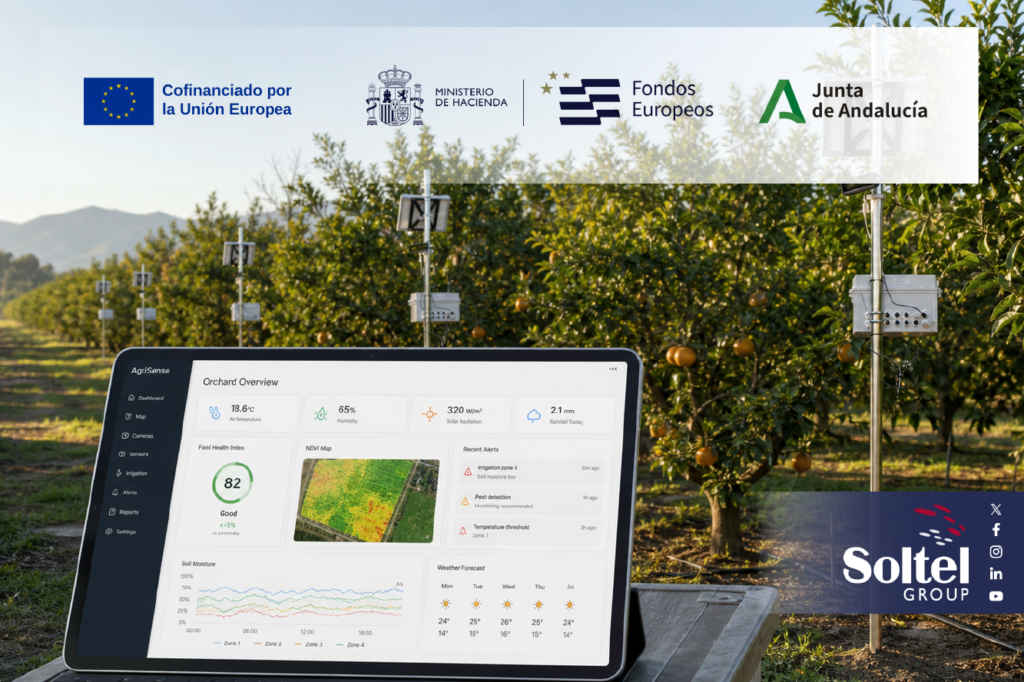
Over the past few months, ReDuCit's integrated digital platform has progressed from the conceptual design phase to a more mature stage of functional definition and data architecture. The work carried out has allowed for the consolidation of input variables, processing flows, and the necessary structure to coherently integrate information from sensors, machine vision systems, and complementary agronomic data.
This evolution reinforces the platform's role as the project's operational core, as it not only centralizes information but also transforms it into interpretable indicators for decision-making. In this phase, development has focused on facilitating the generation of relative water stress indicators, fruit growth rates, and irrigation recommendations more closely aligned with the crop's actual needs.
Data integration and validation under real-world conditions
The results obtained so far have served to prepare the next stage of the project, focused on the definition and implementation of Controlled Deficit Irrigation management protocols. This task will be approached on a more robust basis, supported by the information generated during the experimental campaigns and the integration of the different lines of work developed by the consortium.
Validation under real-world production conditions, using a Living Lab approach, will allow for testing the solution's operability in a commercial environment and evaluating its impact on water efficiency and crop productivity. In this way, ReDuCit is moving towards an applied solution, with the potential for transfer to the sector and the capacity to be adapted to other woody crops.
A collaborative project to promote more sustainable agriculture
ReDuCit, led by onTech Innovation in collaboration with the SBL Research Group at the University of Seville, Rovimática, and Soltel, is progressing as a comprehensive solution to improve irrigation management in citrus orchards by combining advanced monitoring, machine vision, and a digital decision support platform. As the project advances, it is consolidating an approach capable of transforming field data into actionable information for adjusting irrigation more precisely and reducing water consumption without compromising productivity.
The participation of the Irrigation Community of the Lower Guadalquivir Valley is proving especially relevant in grounding the development in an operational environment and verifying its usefulness in the field, as well as in guiding the development towards specific needs of the sector.
Thanks to this framework, the project not only progresses in technical terms, but also gains in transferability, with a clear orientation towards the practical adoption of the solution and its possible extension to other cultivation systems.
The Initiative (with file number PLSQ_00231_1), is financed by the Junta de Andalucía, Consellería de Universidad, Investigación e Innovación en el marco de la calle PLAnd Sequía Andalucía, charged to the FEDER Andalucía 2021-2027 programme and own resources, designed in line with the guidelines of the Strategy for Research, Development and Innovation of Andalusia (EIDIA) 2021-2027 and the Strategy for Smart Specialisation for Sustainability of Andalusia, S4 Andalucía.