


The hyperspectral technology it is an optical technology that allows the analysis of light reflection across different regions of the electromagnetic spectrum, covering a large number of wavelengths, which can range from near infrared to visible depending on the application, although for most practical applications, it is the infrared bands (Near Infrared, NIR) -770 nm to 2500 nm- that offer the most relevant information in classification and pattern detection tasks.
Thus, hyperspectral signatures allow the identification and characterization of the chemical composition of materials and, in the case of the project SCOUTThey are used to analyze in the field the specific characteristics of table olives, such as their degree of maturity, in order to optimize the harvest time.
Multispectral signatures in SCOUT
Using a prototype handheld device designed and developed within the project, capable of being operated by a single person, and equipped with multispectral sensors covering the range of spectral bands relevant to the specific study of table olive characteristics, information is obtained through field sampling. The data obtained comprises spectral signatures in the 400-1000 nm range, which are processed to obtain organoleptic characteristics of the analyzed olives.

The fact that the handheld device developed focuses, after a specific analysis, on those wavelengths that have the greatest correlation with the parameters to be measured of the olive, allows for a drastic reduction in both the size and cost of these devices, while maintaining high functionality.
On the other hand, the SCOUT system has a mobile system that collects multispectral images from a camera mounted on a zip line to provide relevant information from the point of view of the context where the fruit grows, which complements the information about the fruit itself.
Artificial intelligence
The information collected by the sensors, both in the handheld and mobile systems, is analyzed from an algorithmic point of view using Artificial Intelligence techniques, which in the case of SCOUT are based on neural networks with deep learning (Deep Learning, DL).
In this way, after analyzing the information obtained from the multispectral devices, it will be possible to offer expert assistance to the farmer for optimal decision-making.
The Artificial Intelligence model is responsible for analyzing and classifying the data to obtain variables of interest about the fruit, such as the maturity of the olive or the variety of the same by processing the images captured with a handheld device, or the greenness, density and health of the plantations from the NDVI (greenness index) images obtained with the mobile device.
Cyber-physical system
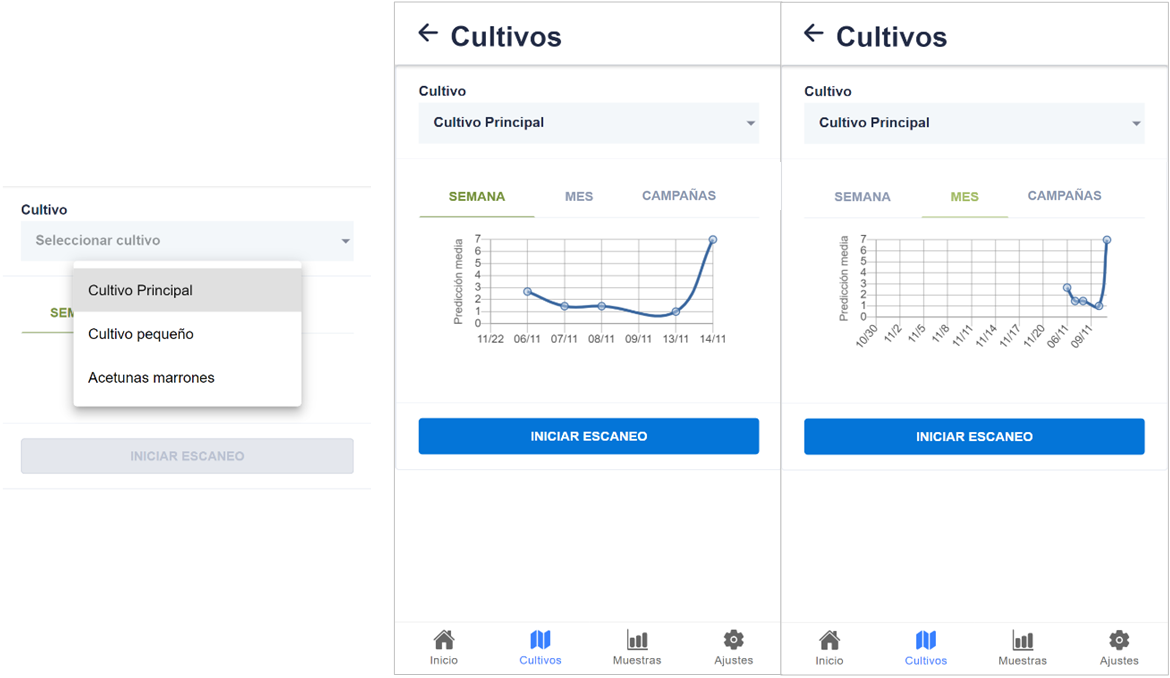
These complex algorithms can be run from a digital platform that also allows both technicians and farmers to access the captured information and the results of the analyses through a web interface and an app.
These interfaces are the visible part of the platform and the part with which the user interacts, thus constituting the link between the user and the SCOUT system.
The web application serves as the primary user interface. Accessed through web browsers, its functions range from data presentation to configuring the business layer, which is crucial for farmers and technicians. This application dynamically interacts with the backend's REST API to retrieve and send information, providing an optimal user experience.

As for the mobile application (App), it serves as an auxiliary interface for data querying, but its main purpose is to allow data collection and to communicate the handheld device with the rest of the system through the use of the device's Bluetooth on which it is installed.
This project has the financial support of the European Union through the funds Next Generation EU within the framework of the 2021 call for aid intended for research and development projects in artificial intelligence and other digital technologies and their integration into value chains (C005/21-ED)


